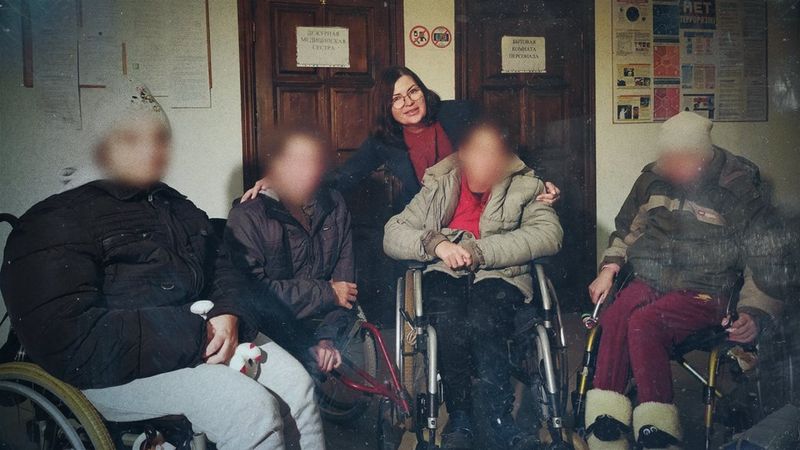
So-called Minister of Labor and Social Protection of the occupation authorities of Kherson region Alla Barkhatnova with residents of the Dnipryansky psychoneurological boarding school. In November 2023, they were sent to a boarding house in Penza. Propaganda publication “Novy Kherson”.
When in February 2022 russian troops entered the territory of Ukraine, 42 psychoneurological boarding schools and psychiatric hospitals in nine regions of Ukraine ended up in the combat zone, surrounded and under occupation. 17 institutions were liberated within the first 100 days.
Journalists from the Suspilne Investigations Editorial Office found out which institutions remain under occupation, what happened to the residents and patients who were there, and why they could not be evacuated at the beginning of the full-scale invasion.
Kherson region: occupiers took residents to Crimea
The figures above were provided to Suspilne investigators by human rights defender Olena Temchenko from the NGO “Ukrainian Human Rights Initiatives”.
The National Social Service of Ukraine indicated in response to our request that under occupation "15 psychoneurological boarding schools remained territorially" and that as of January 1, 2022, almost three thousand people lived there and received social services.
We sent requests to regional military administrations in nine regions to clarify further.
The Kherson OVA replied that before the full-scale invasion, the territory of Kherson region had one psychiatric hospital and five psychoneurological boarding houses.
The Kherson Regional Psychiatric Care Institution had 566 patients, the Kherson Psychoneurological Boarding House — 395 residents, the Ushkalsky Male Boarding House — 66, the Dnipryansky — 120, the Kairsky — 330, and the Oleshky Psychoneurological Boarding House — 33.
At the beginning of the invasion, the Kherson Regional Psychiatric Care Institution stopped providing planned inpatient psychiatric care — only urgent inpatient, outpatient psychiatric, and narcological care was provided.
In April 2023, Suspilne journalists reported that during the occupation the institution faced a shortage of medicines and the threat of forced evacuation of patients, the number of whom in the hospital changed during the occupation. The Kherson OVA explained this as “patient discharges and new admissions to the institution.”
As of November 11, 2022, when Kherson was de-occupied, 407 patients remained in the institution. During November, 257 of them were evacuated to other regions of Ukraine. In October 2023, another evacuation of patients to other regions took place. According to the Kherson OVA, the hospital continues to operate normally.
After the de-occupation of the right-bank part of Kherson region, 300 residents of the Kherson Psychoneurological Boarding House were also evacuated to other regions. Nine were taken home by relatives, journalists were told in response to their inquiry.
However, the Kherson OVA did not mention that 54 female residents of this boarding house were in October 2022 taken allegedly to Crimea by the occupiers. In December 2022, the publication Babel reported this. Their fate is still unknown. On the website of the Office of the Prosecutor General of Ukraine, we found a suspicion against the former director of the boarding school, Borys Shutikov, for cooperating with occupiers and deporting residents to Crimea.
The Kherson OVA reported that as of early March, four boarding institutions remained under occupation: Dnipryansky, Oleshky, Ushkalsky, and Kairsky psychoneurological boarding houses. The occupation authorities changed the management, staff, and “evacuated” residents under the guise of rehabilitation to Crimea and russia.
Journalists of the Suspilne Investigations Editorial Office analyzed where exactly people were taken.
In November 2022, more than a hundred residents of the Dnipryansky psychoneurological boarding house near Nova Kakhovka were forcibly taken by russian military to temporarily occupied Crimea. Some were sent to the russian city of Penza and placed in the “Kvartal Luyi” social adaptation center, which on November 18, 2023, was sanctioned by Ukraine. The deportation was assisted by the Commissioner for Children’s Rights under the President of russia, Maria Lvova-Belova, for whose arrest in 2023 the International Criminal Court issued a warrant for the illegal transfer of Ukrainian children.
In November 2023, another four residents of the boarding house were sent “for rehabilitation” to Penza.
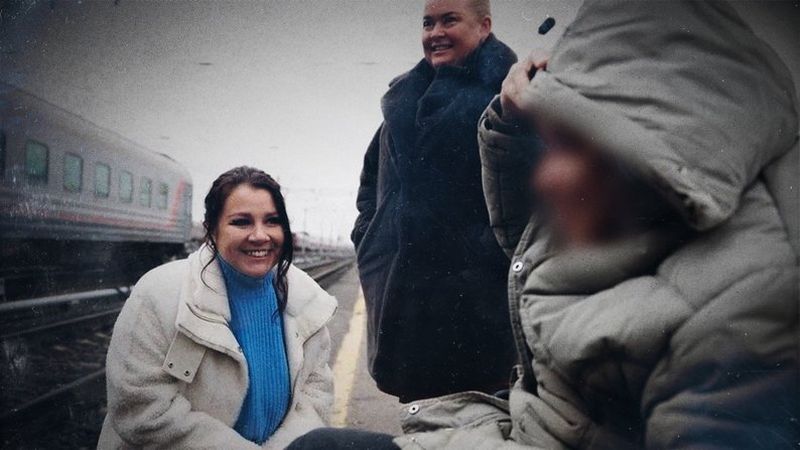
Executive director of the “Kvartal Luyi” social adaptation center Sofia Lvova-Belova (left) meets residents of the Dnipryansky psychoneurological boarding house in Penza, russia. Page “Kvartal Luyi” in a russian social network.
In russian registries, there is information that the occupiers renamed the Ukrainian institution from Dnipryansky to Dniprovskiy. Director Volodymyr Semenov agreed to cooperate with the russians and managed the boarding house until October 2023. In July of that year, he told the russian publication “Tavriya.Kherson” that the residents had everything they needed and volunteers provided great help.
The propaganda story also stated that 70 people were “fully provided” in the boarding house, including 31 from the Oleshky Psychoneurological Boarding House, which the occupiers finally closed in February 2024.
Since October 2023, four directors have changed in the institution. In March 2025, businessman Mikhail Vladimirovich Chicherin from Rostov region was appointed as director. How many residents are currently in the institution and what happened to those taken is unknown.
In November 2022, russians forcibly “evacuated” over 300 residents of the Kairsky psychoneurological boarding house in the village of Kairakh, Hornostaivka district. The russian Ministry of Emergency Situations reported that people were sent by buses to Crimea, and from there by train to Krasnodar Krai and Volgograd region. In October 2024, the Kairsky psychoneurological boarding house ceased functioning under occupation .
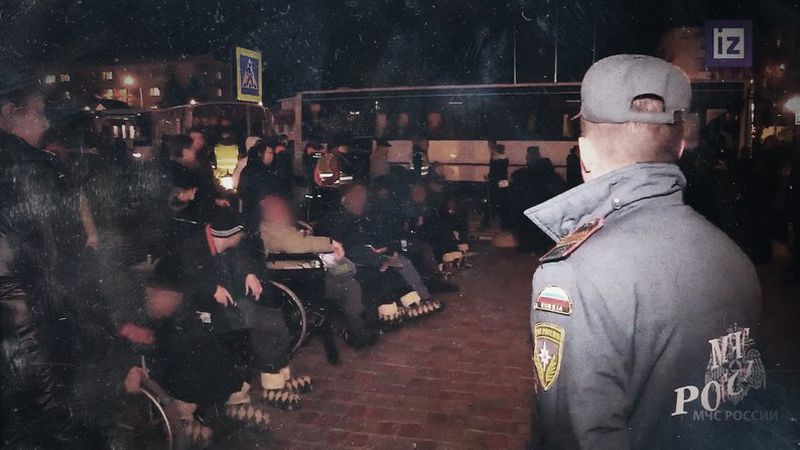
Residents of the Kairsky psychoneurological boarding house being taken by russians to Krasnodar Krai and Volgograd region. Screenshot from REN TV video, November 11, 2022.
Whether residents of the Ushkalsky Male Psychoneurological Boarding House in Verkhnerohachytsky district were evacuated is unknown. In one of the occupation telegram channels, we found information that in April 2024, “volunteers” delivered humanitarian aid from Saint Petersburg. Since January 2025, the occupation director of the boarding house is Oleksandr Borysovych Shebanov, a resident of Ushkalkiv village.
In March 2024, the russian propaganda publication “TASS” published news that Dniprovskiy and Ushkalsky psychoneurological boarding houses had funding problems. It was reported that the residents were fed only by food provided by volunteers, and repairs of equipment and premises were done by the staff at their own expense.
The Kherson OVA in response to Suspilne’s inquiry did not mention the Oleshky Children’s Boarding House, where children with severe disabilities and various mental and intellectual deviations were kept, taught, and treated. In November 2022, as Zmina reported, some children from this boarding house were illegally taken by occupiers to a psychiatric hospital in Strohonavka village, Simferopol district, Crimea. In a post by ombudsman Lubinets, published on November 5, 2022, it mentions 12 children aged 9 to 17.
In July 2023, it became known that the Oleshky Children’s Boarding House was relocated by the occupiers to Skadovsk, Kherson region, headed by former local driving school director and collaborator Vitaliy Suk. At the end of 2024, Suk came under UK sanctions for his involvement in the forced deportation of Ukrainian children. Commenting on the accusations, Suk told the russian publication that since early 2022, the institution handed over nine children to Ukraine. As of spring 2025, the institution continued to operate. In March 2025, a video in a russian social network showed children asking to fund the institution and build a new playground.
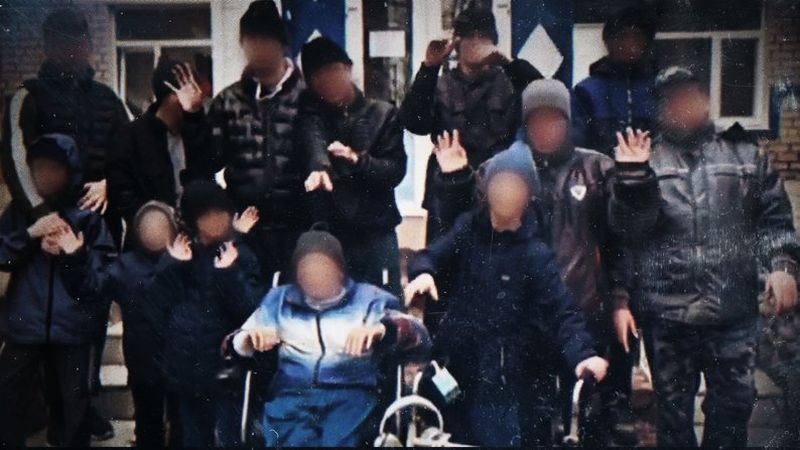
Children of the Oleshky Children’s Boarding House in March 2025. Screenshot from a video in a russian social network.
Zaporizhzhia: Evacuation of Residents Continues
Before the full-scale invasion, three psychiatric hospitals operated in Zaporizhzhia region: the Regional Clinical Institution of Psychoneurological Assistance and Socially Significant Diseases, as well as the Berdyansk and Melitopol psychiatric institutions.
There were also seven psychoneurological boarding schools in the region: Veselivskyi (293 residents), Liubitskyi (134 residents), Liubomyrivskyi (215 residents), Tavriiskyi (410 residents), Preslavskyi (337 residents), Orlovskyi (202 residents), and Mykhailivskyi (259 residents).
Residents of Tavriiskyi and Liubitskyi psychoneurological boarding schools in Orikhiv and Novomykolaiv districts were evacuated to safer territories within Zaporizhzhia region and other regions of Ukraine. The relocation of the institutions themselves was not carried out, and employment relations with staff were suspended, Zaporizhzhia OVA told Suspilne in response to a request.
As of March 19, 2025, 716 people remained in three psychoneurological boarding schools located near the frontline. Zaporizhzhia OVA discussed their evacuation to safe regions. For example, Liubomyrivskyi boarding school from Vilnianskyi district was planned to be relocated to Boryslav community, Lviv region.
Evacuating residents of Preslavskyi, Orlovskyi, and Mykhailivskyi psychoneurological boarding schools, as well as patients of the psychiatric hospital in Berdyansk, which fell under occupation in 2022, was not possible. Zaporizhzhia OVA explained this by "the suddenness and intensity of hostilities and the absence of an official 'green corridor.'"
Preslavskyi psychoneurological boarding school in the village of Preslava, Prymorsk district, still operates. In November 2024, the occupation authorities of Zaporizhzhia region reported that 292 people lived in the boarding school. Residents are actively used in propaganda of Russian values. The director before the full-scale invasion was Yevhenii Rupchev. After the occupation, he began collaborating with the Russians. Rupchev has now been notified of suspicion of collaboration.
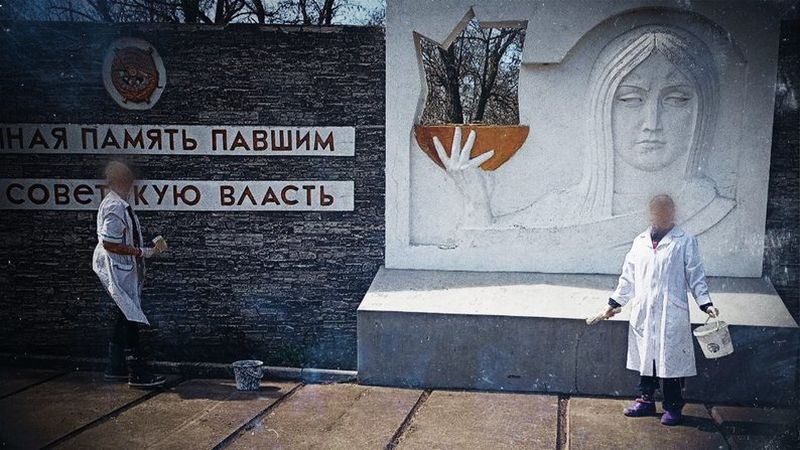
Residents of Preslavskyi psychoneurological boarding school cleaning the territory for the 80th anniversary of the 'great victory', April 2025. Telegram channel of Preslavskyi PNI.
Also operating is the Orlovskyi psychoneurological boarding school in the village of Orlove, Melitopol district. The propaganda channel "Za TV" in 2024 reported that the institution housed almost 200 people. Residents were used in Russian propaganda: forced to say that "Russia helped them more than Ukraine." Director Tamara Vereshchahina cooperated with the occupiers, thanking Russia for coming and Putin for not staying indifferent.
Mykhailivskyi psychoneurological boarding school in the village of Pokazne, Mykhailivskyi district, also operates. A 2023 Russian video stated that the institution had 218 residents. Before the invasion, the director was Vitalii Ponomarenko. By order of Zaporizhzhia regional governor Balitsky, Ponomarenko was expelled from the temporarily occupied territory of Zaporizhzhia region.
Investigations by Suspilne described forced deportations of Ukrainians by the occupiers in "Callsign ‘Batman’".
As of May 2025, the director of Mykhailivskyi boarding school is Vladislav Allegovich Stolyarenko from Krasnodar Krai, Russia. In July 2023, he told propaganda media that due to shelling, residents were first relocated to other boarding schools in the region, then returned.
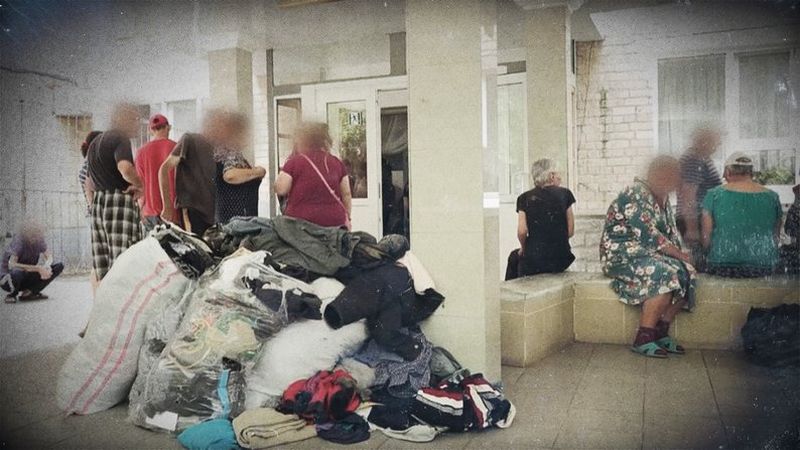
Residents of Mykhailivskyi psychoneurological boarding school returning to the village of Pokazne after evacuation, July 2023. Screenshot from a Russian social media video.
The number of patients in Berdyansk and Melitopol psychiatric hospitals at the time of the full-scale invasion, which fell under occupation, was not provided by Zaporizhzhia OVA.
Investigative journalists from Suspilne spoke with the former director of Berdyansk psychiatric institution, Dmytro Hertsen, who was in Berdyansk during the first month of the invasion. He reported that 90 patients were present at that time, and all stable patients were discharged.
"For a month during my work under occupation, evacuation was not offered. It was very difficult to organize humanitarian corridors to evacuate patients. Since our institution was previously built as a military hospital, there was a bomb shelter with an underground entrance. We also installed toilets there. We had our own kitchen and food supplies. Volunteers brought us rations in the first days of the war. Medicines were also purchased. But there were power outages, no gas, no heating, so we had the challenge of keeping the patients warm," said Hertsen.
Understanding that occupiers would try to coerce him into collaboration, Hertsen decided to leave: "Once, while I was at the hospital, two men in civilian clothes came. I thought they were some kind of special services or FSB, because their language was calm and persuasive. They asked if we needed food, medics. I refused. Then they came again. I realized they would try to coerce collaboration differently. So I transferred authority to one of my deputies and left the city."
Currently, the Berdyansk hospital is headed by Aliona Dikhtiar, previously deputy director. In January 2024, the SBU in Zakarpattia issued a suspicion of state treason against her. Dikhtiar repeatedly gave interviews to propaganda media and did not allow medical staff without Russian passports to work. She also joined the council of chief doctors under the occupation health department.
The Zaporizhzhia Regional Center for Psychiatric and Narcological Care on occupied territories has two branches: in Molochansk and Melitopol. Since the start of the invasion, there has been no contact with the facilities, the Zaporizhzhia OVA Health Department reported.
As of February 24, 2022, the Molochansk branch, according to Zaporizhzhia OVA, had 30 patients. The occupiers created a branch of the "Regional Center for Psychiatric and Narcological Care in Berdyansk." In November 2024, the occupation administration published a photo of the branch, stating that since 2022, 67 staff work there and the number of patients may reach 50.
Luhansk Region: Directors of Occupied Boarding Schools Cooperated with Russians
Before the full-scale invasion, three psychiatric hospitals operated in Luhansk region: Lysychansk and Svatove regional psychiatric hospitals, as well as the Mental Health Center in Sievierodonetsk. At the end of 2021, according to Luhansk OVA Health Department, 555 people were treated there.
After the invasion began, all patients of the Mental Health Center were discharged home. At the end of March 2022, 46 patients of the Lysychansk psychiatric hospital were evacuated.
327 patients of Svatove regional psychiatric hospital could not be evacuated. The Health Department explained this by "the rapid occupation of Svatove district." "Zmina.info" reported in October 2022 that Russian occupiers evicted patients and used the hospital's underground facilities for military purposes.
There were six psychoneurological boarding schools in Luhansk: Popasniansky (124 residents at the time of invasion), Nizhniansky (135 residents), Novoastrakhansky (73 residents), Teplivskyi (109 residents), Dmytrivskyi (276 residents), and Starobilskyi (167 residents).
Residents of Popasniansky and Nizhniansky boarding schools were evacuated to Chernivtsi and Cherkasy regions.
Under occupation remained Teplivskyi, Dmytrivskyi, Novoastrakhansky, and Starobilskyi schools — with 952 residents.
Teplivskyi psychoneurological boarding school continues to operate in the temporarily occupied village of Teplomu, Stanytsia-Luhanska district. On the institution's Russian social media page, there are posts showing how residents voted in the Russian presidential elections and how they are involved in "subbotniks". Until January 2025, the school was headed by Svitlana Rudenko, who also headed it before the invasion. Rudenko agreed to cooperate with Russians and actively promoted Russian propaganda. The current director is Russian Marina Borovskaya from Volgograd region.
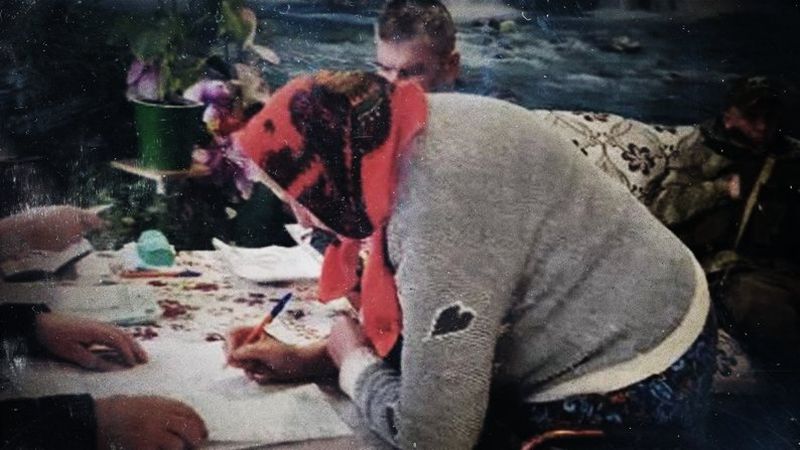
A resident of Teplivskyi psychoneurological boarding school votes in the Russian presidential elections, March 2024. Institution's Russian social media page.
At the beginning of 2023, the occupation authorities appointed Acting Director of Dmytrivskyi psychoneurological boarding school in the village of Dmytrivtsi, Novoaydar district, Aleksandr Aleksandrovich Bondarev from Volgograd region, and in March 2025 — Lyudmila Nikolaevna Vasilik, also from Volgograd region. Social media pages show how residents are used to promote Russian propaganda. Russian military are invited to the institution.
Novoastrakhansky psychoneurological boarding school in the village of Nova Astrakhan, Kreminsky district, also continues operating under occupation. The occupiers left Oleksandr Filenko as director, who headed the school before the invasion. No public data is available on the number of residents remaining.
Donetsk Region: All Residents Were Evacuated
Before the invasion, three psychiatric hospitals in Donetsk region operated, with 935 beds, as well as four psychoneurological boarding schools. According to Donetsk OVA responses to Suspilne requests, hospitals were in Mariupol, Kramatorsk, and Sloviansk. At the start of the invasion, the Mariupol hospital building was damaged, and documents and property remained on occupied territory. According to Donetsk OVA, all three hospitals continue to operate, with Mariupol hospital relocated to Kyiv.
The boarding schools in Donetsk were: Bakhmut psychoneurological boarding school (299 residents as of 24.02.2022), Komyshivskyi (324 residents), Pokrovskyi (474 residents), and Sloviansky (398 residents). All residents were evacuated between March–June 2022 to other institutions in Ukraine and abroad, including Spain, Latvia, and Italy. Buildings of Bakhmut and Komyshivskyi boarding schools, now on temporarily occupied territory, were completely destroyed.
As of March 2025, only one of the four Donetsk boarding schools officially operates — Bakhmut. It was relocated to Poltava region, with 100 beds deployed.
OVA officials also noted that during evacuation, Donetsk region faced a shortage of free spaces in boarding institutions of other regions. The need for inpatient care for residents requiring assistance still exists.
"The Unlearned Lesson of 2014"
To clarify why patients and residents of psychiatric hospitals and boarding schools could not be evacuated at the start of the invasion and remain under occupation, Suspilne investigators consulted human rights defenders, the Ombudsman Office, Ministry of Social Policy, Ministry of Health, and the National Social Service of Ukraine.
According to human rights activist Olena Temchenko from NGO "Ukrainian Human Rights Initiatives," although psychiatric hospitals and boarding schools are communal, under the Convention Against Torture and Other Cruel, Inhuman or Degrading Treatment or Punishment, the state is responsible for life and human rights protection.
The Ministry of Health and Ministry of Social Policy forwarded requests to regional military administrations.
We asked the Ombudsman Office whether they could monitor the rights of patients and residents in occupied psychiatric facilities, whether they recorded violations, and whether they contacted international organizations for information from occupied institutions. No answers were provided.
Olena Temchenko, who worked in the Verkhovna Rada Ombudsman Office before the invasion, asserts that neither psychoneurological boarding schools nor other facilities for people with disabilities were prepared for evacuation.
According to her, every institution, organization, or enterprise should have had evacuation plans for patients and residents. The Department for National Preventive Mechanism of the Ombudsman Office developed evacuation recommendations as early as 2014, when parts of psychiatric hospitals and boarding schools in Donetsk and Luhansk regions were on temporarily uncontrolled territory.
"Evacuation plans are supervised by the State Emergency Service under the Ministry of Internal Affairs. In 2017, the Ministry issued an order approving Evacuation Planning Methodology. According to the order, the evacuation plan should be updated and approved yearly. Unfortunately, while fire evacuation plans in boarding schools were checked semiannually, evacuation plans were not checked until 2022. This is the unlearned lesson of 2014. In the first days of the invasion, the strong defense and heroic resistance in Donetsk allowed evacuating residents. In Luhansk, some schools ended up under occupation. Even in areas expecting a Russian offensive, there was no readiness for evacuation," says Temchenko.
She adds: in the first days of the invasion, some boarding school directors were ready to evacuate residents: "But there was no command. People were in despair because they were told everything was ready, all algorithms were ready. But they called and said: 'We were told to figure out where to evacuate ourselves.'"
No documents regulating evacuation of psychoneurological boarding schools or psychiatric hospitals at the start of the invasion were found publicly.
There were emergency response plans approved by Cabinet Resolution No. 11 in 2014 and regional population evacuation plans. However, at the time of the invasion, many plans were outdated, not adapted to full-scale war conditions, or did not provide evacuation under shelling, occupation, or loss of territorial control, according to Temchenko.
The Cabinet resolution regulating evacuation under martial law was adopted only on March 27, 2022. On March 1, 2023, it expired. A new one appeared on June 1, 2023 — No. 546 "On Temporary Relocation (Evacuation) of Children and Persons Residing or Enrolled in Institutions of Various Types for 24-Hour Stay and Their Return".
Whether the state plans to evacuate psychiatric hospital patients and residents of psychoneurological boarding schools who ended up under occupation at the start of the invasion and remain there, and whether any actions are being taken, no institution has responded to our inquiries.