

Larisa Boyuk, expert of NGO “Ukrainian Human Rights Initiatives”
Deinstitutionalization reforms are ongoing in Ukraine, yet thousands of people in psycho-neurological institutions and boarding houses remain legally “invisible.”
Experts from the NGO “Ukrainian Human Rights Initiatives” present the study “Legal Capacity of Residents of Institutional Facilities: Problems and Ways to Overcome Them,” focused on the rights of incapacitated persons, conducted with the support of the International Renaissance Foundation.
The results are discouraging: the care system has turned into a tool for total control over residents’ lives, and the path to restoring their rights is virtually closed.
During the study, which covered 50 institutional facilities in 10 regions of Ukraine and Kyiv, systemic violations of the rights of over 4,000 residents of psycho-neurological institutions, orphanages, and geriatric boarding houses were identified. The conclusions of the NGO experts indicate direct violations by Ukraine of Article 12 of the UN Convention on the Rights of Persons with Disabilities.
44% of residents — deprived of autonomy in decision-making
The data is evidence of a systemic crisis persisting for decades. The figures speak for themselves: out of 9,340 residents of these facilities, 4,056 people (43%) were legally declared incapacitated by court, and another 66 (1%) have limited capacity. This means that every second resident of an institution is deprived of the legal ability to make decisions about their life — from everyday matters to the possibility of changing their life and leaving the institution. They are also deprived of fundamental rights such as marriage, voting, or accessing education.
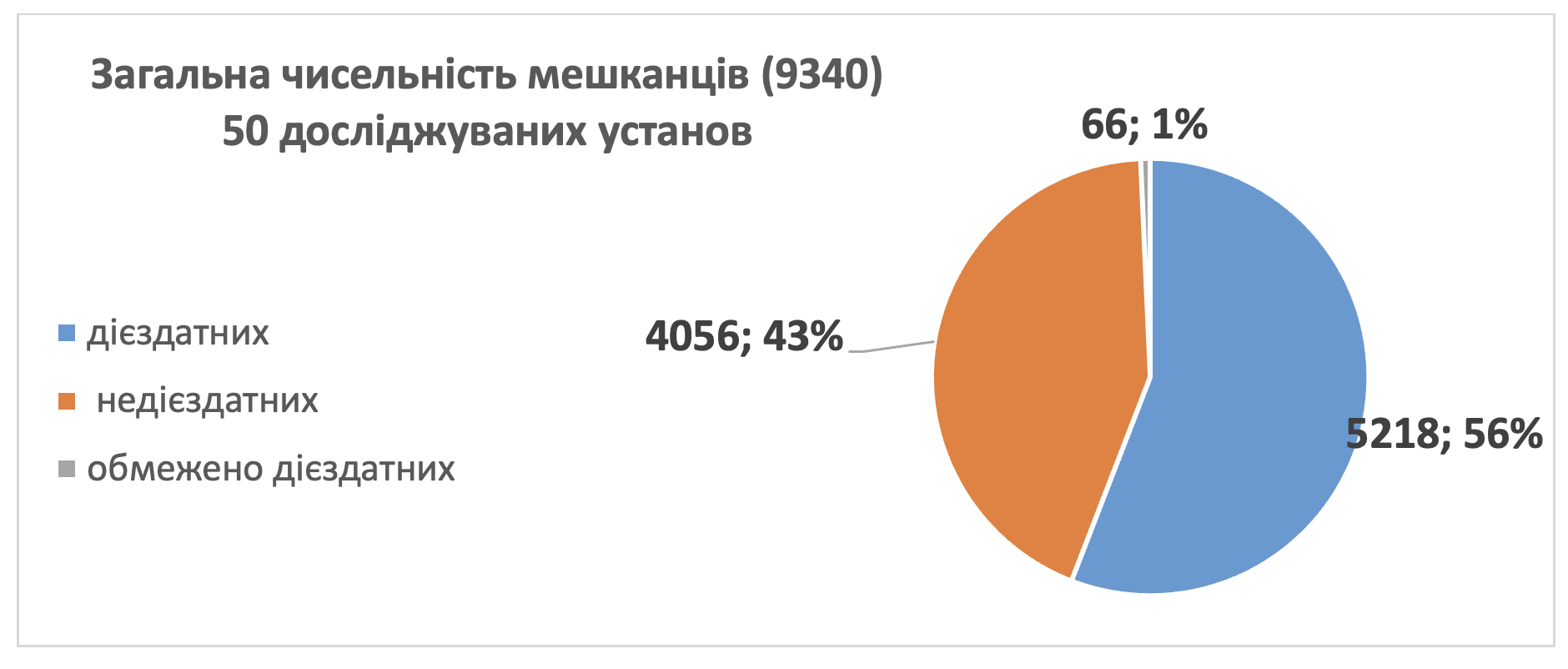
In fact, this is a violation of the human right to legal capacity, guaranteed by Article 12 of the UN Convention on the Rights of Persons with Disabilities.
The highest figures are in children’s homes (DBI), where youth aged 18 to 35 live. Here, the share of incapacitated residents reaches 80-100%. When residents with intellectual disabilities reach adulthood, DBIs, instead of providing support for independent living, see the only solution as depriving them of capacity.
Geography of Powerlessness: 20% to 88%
The map of incapacity in Ukraine is a map of legal inequality. The study revealed discrepancies that cannot be explained by the objective health status of people.
The highest rates (79–88%) are in Kyiv and Odesa regions. In the Sviatoshyn PNI (Kyiv), 89% of residents are incapacitated. In Ananiv and Krasnosilski orphanages in Odesa, this statistic is supported by Soviet-style institutions with nearly 100% incapacity.
The lowest rates (15–20%) are in Lviv and Kharkiv regions, where only 15–20% of residents are incapacitated, reflecting fundamentally different approaches by the institutions and courts.
This discrepancy is a clear indicator that the level of incapacity depends not on medical diagnoses but on local customs, historical practices, and the involvement of relatives or facility management.
Director as Guardian: Legal Conflict of Interest
One of the sharpest problems identified by human rights defenders is the mass appointment of institution directors as guardians of their residents. The “institutional care” model is one of the largest systemic violations.
International human rights organizations have repeatedly highlighted this issue. The European Committee for the Prevention of Torture (CPT) in its 2020 report (CPT/Inf (2020) para. 44), based on visits to institutions in 2019, expressed serious concern that most residents have the institution itself as their guardian.
According to the Committee, such practice creates an obvious conflict of interest and does not ensure the independence or impartiality of guardianship. CPT has repeatedly emphasized that a guardian should act exclusively in the best interests of the ward, whereas combining management and guardianship functions greatly increases the risk of human rights violations. Consequently, the Committee urged Ukrainian authorities to abandon the practice of appointing institutions as guardians and to seek alternative solutions ensuring real independence of guardians and proper protection of incapacitated persons’ rights.
However, despite CPT recommendations, the situation in Ukraine has not changed substantially: courts continue to use different approaches to guardianship, including appointing the director of the institution personally or as a legal representative under Article 66 of the Civil Code of Ukraine.
19.4% of all incapacitated residents — almost one in five — have the institution director as their guardian, creating a fatal conflict of interest: one person simultaneously manages the facility’s budget, the care of residents, and the protection of their personal and property rights.
According to the study, in many facilities, this rate reaches critical levels. For example, in Hrabariv PNI in Poltava region (86% under director guardianship), Balta PNI in Odesa region (83%), Myrohoshcha PNI in Rivne region (77%), Antopil PNI in Vinnytsia region (72%), the director essentially holds absolute power over residents’ lives.
“When an institution controls itself through the director-guardian, the voice of the resident disappears. Under such conditions, deinstitutionalization is impossible because the guardian will not initiate a person’s exit from the facility they lead,” the study’s experts note.
Overall, only one-third of the incapacitated residents out of over 4,000 have relatives as guardians.
Ghost Relatives: Formal Guardianship Without Support
Even having a relative as a guardian does not guarantee real support for the resident. The study revealed a troubling trend: every seventh resident with a family guardian does not see them at all. A significant portion of residents is deprived even of basic communication with relatives, and the opportunity to return home for leave is available to very few.
The situation is especially critical for those whose guardians have effectively withdrawn from their duties for a long time. This is often due to the objective challenges of the war: many of these guardians are internally displaced or on temporarily occupied territories, making real protection of residents’ rights physically impossible.
The facility director becomes, for the resident, simultaneously law, court, and executor. Such concentration of power in one person turns the institution into a closed system where the person’s legal capacity is annihilated.
Restoring Capacity: Mission Impossible
The mechanism for restoring legal capacity, introduced after amendments to the Civil Procedure Code in 2018, practically does not work. From 2023 to 2025, only 55 applications for restoration were filed — 1.3% of all incapacitated residents. Only 7 applications were granted, i.e., 0.17% of residents had their capacity restored.
Meanwhile, in the same period, 141 people were declared incapacitated — 20 times more than were restored! Moreover, more than half (51.8%) of these incapacitations were initiated by the institutions themselves.
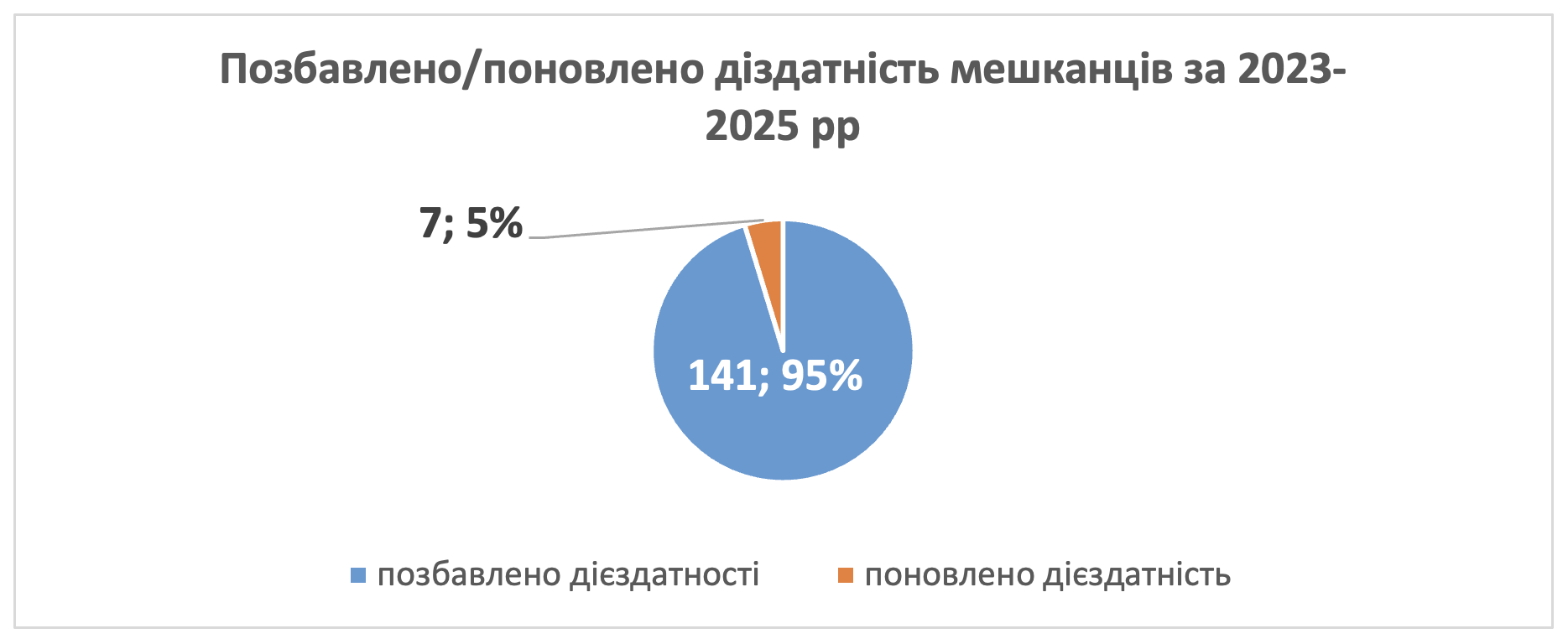
Analysis shows that the mechanism for restoring rights under institutional care remains a “dead” norm.
Ukraine must make a strategic transition from the outdated incapacity institution to a supported decision-making model, focusing on the person’s will rather than their limitations. Legal capacity is the right to have rights. As long as the care system operates under the inertia of the Soviet punitive approach “deprive and confine,” Ukraine cannot build a truly inclusive society.
The study results indicate massive disregard of international human rights standards in Ukraine. Deprivation of capacity in institutions has effectively become a form of institutional violence. In facilities for people with mental and intellectual disabilities, the right to voice, choice, and the ability to manage one’s life is systematically nullified. Ignoring this crisis would mean conscious consent to continue legal segregation, condemned long ago by the civilized world.
The research was conducted based on monitoring visits to institutional facilities and official responses from state authorities within the framework of the national preventive mechanism. An analytical report with recommendations for systemic changes will be presented to the public and authorities soon.
The material was prepared based on research by NGO “Ukrainian Human Rights Initiatives” with support from International Renaissance Foundation. The material represents the authors’ position and does not necessarily reflect the position of the International Renaissance Foundation.


